

Read our latest news
After having a conversation around masking and ADHD, where masking is often described as the conscious or unconscious act of concealing behaviors, traits or characteristics that may be perceived as different, this really got me thinking. I began questioning whether masking is just part and parcel of the day-to-day lives of those with ADHD or perhaps it is woven into many people's daily experiences.
I've often seen it in people who have learned through early experiences that their feelings were "too much", or those who have spent years walking on eggshells through difficult relationships.
I've not only witnessed it in those experiencing addiction but have firsthand lived experience of living this way myself as a former addict. We become experts at presenting a version of ourselves that feels acceptable to the world, whilst hiding all the parts we fear may be judged.
I've seen it in workplaces where people carefully choose which aspects of themselves to expose; monitoring what they say, how they behave and how much of themselves they reveal with the aim to fit within that environment.
How sad though?
I suppose the better question would be: why?
Maybe at its core, it's more related to safety, the fear of criticism, and ultimately the fear of being rejected. This is where I began wondering about the role of Rejection Sensitive Dysphoria (RSD), something commonly associated with ADHD. If criticism, disappointment or rejection feels particularly painful, it makes sense that a person might become more likely to hide parts of themselves so they can avoid that pain.
Perhaps masking doesn't develop simply because someone has ADHD. Perhaps it develops because certain experiences teach us that some parts of ourselves are unacceptable. Over time, a child who repeatedly receives negative feedback about their behavior may become increasingly alert to criticism and rejection. They learn to monitor themselves more carefully. To fit in. To avoid standing out. To avoid being hurt.
If masking is rewarded socially, the message can become clear: you need to hide parts of yourself to be accepted. Eventually, being yourself may begin to feel unsafe.
This leaves me wondering whether masking is really a feature of ADHD itself, or whether it is a response to living with ADHD in a world that doesn't always understand it. If a child grew up feeling accepted, understood and supported, rather than criticized, shamed or excluded, would masking develop in the same way?
Maybe masking is not the ADHD. Maybe it is the survival strategy that grows around it.
This also raises an interesting question around the nature versus nurture debate.
If masking develops as a response to repeated experiences of criticism, misunderstanding, exclusion or rejection, then perhaps it is not solely the result of having ADHD itself. Perhaps it is also shaped by the environment in which a person grows up.
If experiences can contribute to the development of masking, could new experiences—or more accepting and understanding environments—help a child or adult develop greater self-acceptance and, in turn, reduce the need to mask?
This leads me to wonder about the importance of early experiences. Schools, families and the wider environments children grow up in are often where they first learn whether their differences are accepted, understood or criticised.
If children with ADHD are met with curiosity, support and understanding rather than judgement or exclusion, might they feel less pressure to hide parts of themselves to fit in?
Perhaps this is where meaningful change begins—not by trying to change the child, but by creating environments where difference is understood and accepted from the outset.
If that's true, it leads to another question.
Can relationships that are built on acceptance, understanding and psychological safety allow someone to gradually feel less need to hide parts of themselves?
Can increased self-awareness help a person recognise when they are masking and make conscious choices about when, where and with whom they feel safe enough to be more authentic?
Perhaps the goal is not to eradicate masking entirely. We all adapt aspects of ourselves depending on the situation. Perhaps the goal is to create enough safety, both internally and externally, that authenticity no longer feels like a risk. Maybe the opposite of masking isn't complete self-disclosure. Maybe it's having the freedom to choose.
Perhaps the question isn't whether we mask, but why we learned to. Somewhere along the way, many of us began asking ourselves, consciously or unconsciously:
"How much of myself is safe to show?"
Even before becoming a counsellor, I often found myself asking the same question when trying to understand people:
"What happened to them that made them this way?"
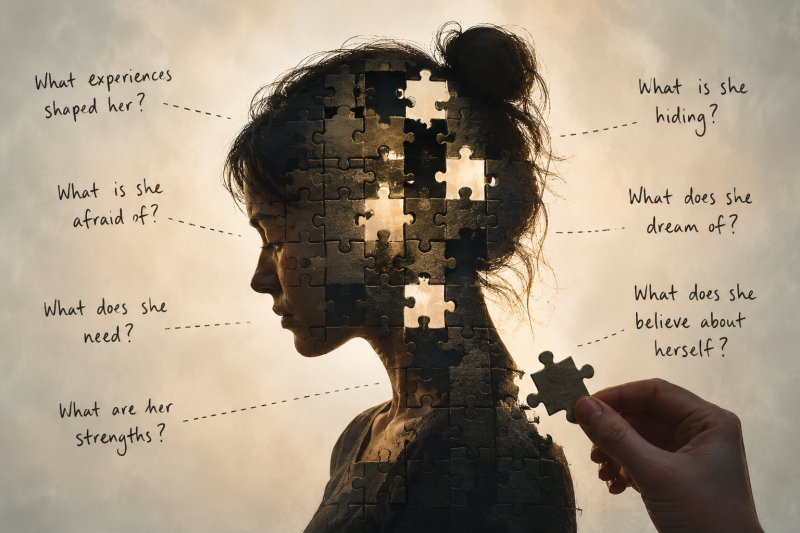
Not in a judgmental sense, but from a place of genuine curiosity. Over time, I realised that most of us make sense when we understand our story. Behaviors that appear confusing, frustrating or self-defeating often have roots in experiences that once served a purpose.
Perhaps that's why I have always loved puzzles. I enjoy piecing things together, noticing patterns and making connections.
Today, I bring that same curiosity into my counselling work. I work alongside clients to help them understand themselves better—not to label or fix them, but to explore how their experiences may have shaped the way they think, feel and relate to the world.
Whether we are talking about masking, addiction, anxiety, people-pleasing or relationship patterns, I am often drawn back to the same question:
"What happened?"
Because when we begin to understand why we became who we are, we can also begin to decide who we want to become. And perhaps that brings us back to the original question:
How much of myself is safe to show?
Maybe the answer depends less on who we are and more on what we've learned about being ourselves in the presence of others.
If this resonates with you, I'd love to hear your thoughts in the comments.



Add comment
Comments