


When Someone Else Sees Something We Struggle to See Ourselves
In my last blog, When Achievement Still Doesn’t Feel Like Enough, I reflected on how difficult it can be to truly accept our accomplishments, even when we’ve worked hard for them.
But after replying to a comment on social media recently, something else dawned on me.
The woman who commented on my post could see something in my counselling work that I still sometimes find hard to recognise in myself.
Looking Beyond the Symptoms
I wrote: “Treating symptoms alone is like painting over a door without stripping off the old layers first. It may look better for a while, but eventually the paint begins to peel.”
At the time, I was simply describing how I see therapy. That meaningful change often comes from understanding what sits underneath our coping mechanisms, reactions, anxiety, self-doubt or survival patterns rather than simply trying to cover over them.
But afterwards, it dawned on me. Why is it often easier for others to recognise our depth, compassion, knowledge or ability than it is for us to recognise it ourselves?

When Competence Isn’t the Problem
I think many people, like me who work within helping roles — quietly carry a self-worth wound that has nothing to do with competence.
You can work as hard as you can. You can care deeply. You can help others profoundly.
And still question yourself afterwards.
Sometimes the issue isn’t a lack of skill but rather it’s the lens we’ve spent years looking at ourselves through. Maybe part of healing is not only understanding the layers beneath our pain, but also learning to see ourselves more clearly beneath the old stories we still carry.

You Can Like Yourself and Still Struggle with Self-Worth
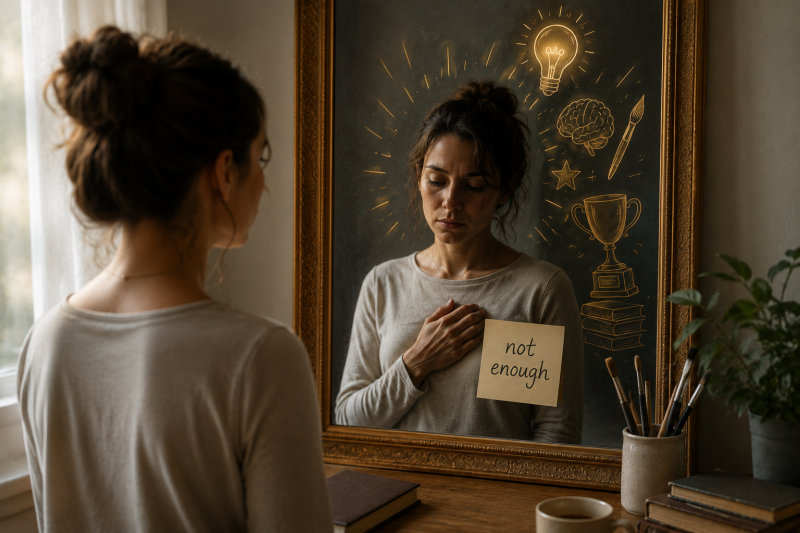
One of the strangest emotional experiences I have had is realising that I’ve come to a stage in my life that I now genuinely like myself… but underneath I still quietly feel “less than.”
People rarely talk about that contradiction, but I believe that’s probably because we often treat self-worth like it’s black and white: either you’re confident and secure, or insecure and full of self-hate. But life doesn’t really work like that.
You can become someone thoughtful, resilient, emotionally aware and kind… and still carry old feelings of not quite being enough.
I think that’s because liking yourself and feeling worthy are two very different things.
When Self-Awareness Grows Faster Than Self-Worth
You can see your growth and still struggle to believe you deserve love without proving yourself, rest without guilt, boundaries without fear, or care without feeling you must earn it.
I believe much of our low self-worth isn’t rational. It’s shaped by emotional conditioning and survival, which is rooted deeper than thought.
And sometimes we grow faster than our nervous system catches up. We become more self-aware, more authentic and healthier in how we live, but emotionally still react like the version of ourselves who once had to overperform, stay small, or people-please just to feel safe or valued.
So therefore, it makes sense that one part of us knows our worth, while another still questions it.
Healing Might Be Quieter Than We Think
I don’t think healing is suddenly becoming confident and never doubting yourself again. I think it’s a lot quieter than that.
Maybe it’s more about reframing it — “I still struggle sometimes, but I no longer abandon myself.” Maybe it’s learning to take up space without apologising for it. Maybe it’s realising that self-worth can take longer to feel than self-awareness does.
And maybe the journey was never about becoming perfect. Maybe it’s simply about moving from self-rejection… to self-loyalty.

Add comment
Comments